Skin, Soul, and Silence: What the Bodhrán Is Really Teaching Americans About Rhythm
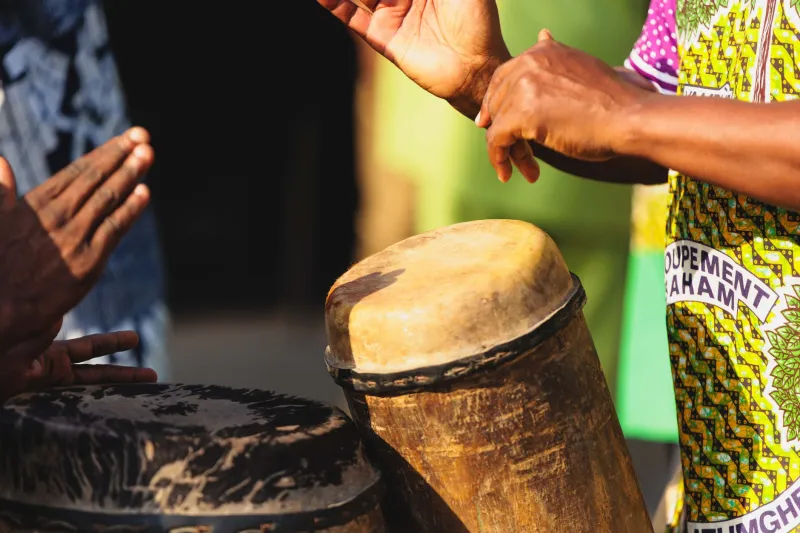
You'd think a drum would be the easy entry point into Irish traditional music. No complicated fingering. No reed to wet. No bow to rosinate. Just a frame, a skin, and a small double-headed stick called a tipper. Pick it up, hit it, keep time. Simple, right?
Wrong. Completely, humblingly wrong.
Anyone who has sat in a session circle and watched a master bodhrán player knows there's something happening that defies easy explanation. The instrument breathes. It converses. It drops out entirely for four bars and then reappears so naturally you wonder if it was ever gone. Ask Seán Ó Treasaigh, who teaches bodhrán workshops out of a cramped studio in Chicago's Bridgeport neighborhood, and he'll tell you what he tells every new student on day one: "Forget everything the drum kit taught you. Forget the click track. Forget the downbeat. You're not keeping time here. You're telling a story with time."
That's a philosophical pivot that stops a lot of Americans cold — and it's exactly why the bodhrán has become one of the most quietly transformative instruments in the Irish-American cultural revival.
The Heartbeat Problem
Western percussion, broadly speaking, is built around a metronome logic. The beat is a grid. You play on it, around it, against it — but the grid is always there, a fixed scaffold. Rock drumming, jazz brushwork, even classical timpani — all of it assumes a steady, democratic pulse that the musician either reinforces or decorates.
The bodhrán doesn't work that way. Its pulse is more biological than mathematical. Players talk about it in terms that sound almost mystical: the instrument should breathe with the tune, not beneath it. The rhythm should feel like something found rather than imposed. In Irish traditional music, the melody carries its own internal momentum — the ornamentation, the triplets, the way a fiddle player might stretch a single note across what feels like three beats — and the bodhrán's job is to shadow that momentum, not anchor it.
"People come in thinking they're going to be the backbone," says Máire Ní Bhriain, who runs an Irish arts program in Boston's Jamaica Plain neighborhood and has been teaching bodhrán to American students for nearly fifteen years. "But the tune is the backbone. The bodhrán is the heartbeat underneath it — and a heartbeat doesn't dominate. It just keeps you alive."
That metaphor — the heartbeat — comes up again and again among players and teachers. It's not accidental. The bodhrán's origins, whatever they actually are (and the history is genuinely murky, contested, and wonderful), are deeply tied to the body. The goatskin head, tightened or loosened by the pressure of the hand from behind, responds to warmth. Players heat it near a fire before a session, or cup it against their body while they wait. The instrument is literally temperature-sensitive. It responds to human touch before a single note is struck.
Unlearning as Practice
Kieran Walsh drives two hours every other weekend from his home in suburban Columbus, Ohio, to attend a bodhrán intensive in Cleveland. He came to the instrument through a St. Patrick's Day performance three years ago — "the usual gateway," he laughs — but has since gone deep enough to perform at local sessions and begin teaching beginners himself.
"The hardest thing wasn't the technique," he says. "I'd played kit in a band for years. The hardest thing was shutting off the part of my brain that wanted to lead. In rock, the drummer leads. In trad, you follow. You listen so hard it almost hurts."
That active, intense listening is something teachers describe as the real curriculum. The tipper technique — whether you use the Kerry style, the top-end style, or the increasingly popular Wexford style with its rolling wrist motion — is learnable in a few months. The listening, the restraint, the understanding of when silence is the most musical choice you can make? That takes years.
Niall Keane, a Cork-born player who relocated to New York a decade ago and now performs regularly with a trad ensemble in Woodside, Queens, describes it as learning to disappear. "The best compliment you can get after a session isn't 'great playing.' It's when a fiddler turns to you and says the music felt really good tonight. That means you served the music. You didn't interrupt it."
Why Americans Are Drawn In
There's something particular about the bodhrán that resonates with American students beyond the novelty of a frame drum. Teachers across the country point to a kind of hunger — for music that isn't optimized, that isn't perfect, that carries roughness and history in its texture.
"People are exhausted by produced sound," says Ní Bhriain. "Everything they hear has been polished to nothing. The bodhrán sounds like something real. Like weather. Like a person."
The instrument also carries an accessibility that democratizes the session in meaningful ways. You don't need years of classical training to begin. You don't need to read music. What you need — and this is where the challenge lives — is the willingness to listen more than you play, and to subordinate your ego to the collective sound of the room.
In a culture that rewards individual performance and visible skill, that's a genuinely countercultural ask. And increasingly, it seems, Americans are ready to make it.
Cultural Memory Through the Skin
For Irish-American players specifically, the bodhrán carries an extra layer of meaning that teachers say they see students discover slowly, almost without realizing it. The instrument connects them to something older than sheet music, older than formal lessons — to a tradition of music made in kitchens and at crossroads, music that wasn't recorded or preserved but survived anyway, passed hand to hand and ear to ear.
"When you play bodhrán in a session, you're not performing," says Walsh. "You're participating. And that participation feels like belonging to something. I can't explain it better than that. It just feels like I belong to something I didn't know I'd lost."
Seán Ó Treasaigh in Chicago puts it more simply. At the end of every beginner workshop, he asks his students to close their eyes and just tap the simplest possible pulse — slow, steady, quiet. "That's your heartbeat," he tells them. "That's where Irish music starts. Not with a tune, not with a jig or a reel. With the sound of a person being alive."
In a frame drum not much bigger than a pizza box, stretched with goatskin and held against the body, Americans are finding something that neither a guitar lesson nor a streaming playlist could give them: the feeling that rhythm, at its deepest level, is not something you impose on music. It's something you remember.