Peat, Pot Stills, and a Bodhrán in the Corner: How Irish Whiskey and Traditional Music Found Each Other in America
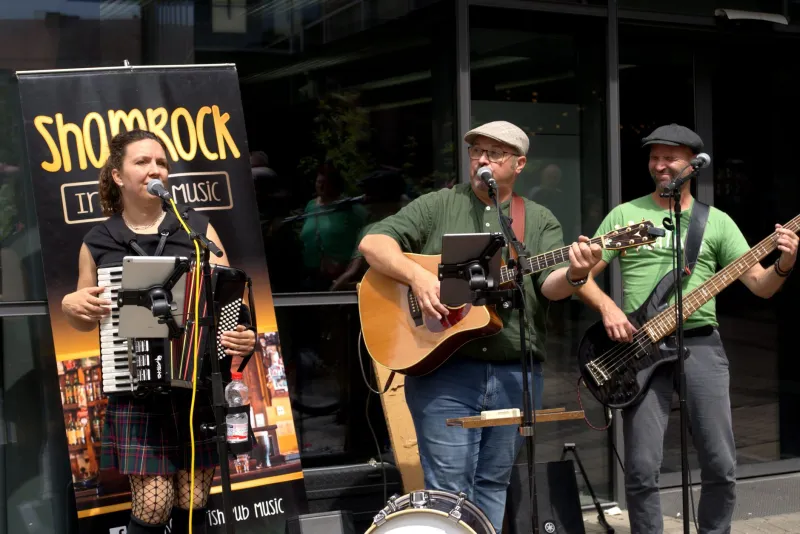
There's a moment that happens in certain tasting rooms these days that nobody quite planned for. A fiddle player tunes up in the corner, a tin whistle answers back, and somewhere between the second dram and the third, the person next to you leans over and says, I didn't know whiskey could feel like this.
That's the idea. And it's catching on fast.
Irish whiskey is the fastest-growing spirits category in the United States — sales have more than tripled over the past decade — and the brands riding that wave are increasingly turning to something unexpected to separate themselves from the noise: live traditional music. Not as background ambiance, not as a Spotify playlist piped through a Bluetooth speaker, but as a genuine cultural anchor. Real sessions. Real musicians. Real stories told through jigs and slow airs while the copper pot stills gleam in the background.
More Than a Marketing Move
It would be easy to dismiss this as clever branding. Slap some Celtic knotwork on a label, hire a fiddle player for the Saturday tour, done. But spend any time talking to the people behind these experiences and you start to hear something more sincere.
Take what's happening at smaller American craft distilleries that have built their entire identity around Irish heritage — operations in places like Philadelphia, Boston, Chicago, and even the Texas Hill Country, where Irish immigrant histories run deeper than most people realize. These aren't just selling a product. They're building an argument that whiskey, like music, is a living tradition. It evolves, it carries memory, and it means something different depending on who's pouring it and who's listening.
Mike Harrington, a distiller based outside of Chicago whose family traces its roots to County Galway, started hosting monthly trad sessions in his tasting room three years ago almost by accident. A friend played fiddle. A few musicians showed up. Customers stayed longer than usual. "People weren't just tasting the whiskey anymore," he says. "They were asking about where my grandfather came from. They were asking about the tunes. The whiskey became a door into something bigger."
That's a dynamic that would feel immediately familiar to anyone who's walked into a pub in Doolin or Dingle on a Tuesday night. The music doesn't perform at you. It pulls you in.
The Session as Cultural Architecture
What makes a traditional Irish session different from a live music show is exactly what makes it such a natural fit for this kind of experience. There's no stage. There's no separation between the musicians and the room. Tunes get passed around, conversations happen between sets, and the whole thing breathes at its own pace. Nobody's rushing toward a finale.
For a whiskey tasting, that rhythm is almost alchemical. A good single malt asks you to slow down, to pay attention to what's in the glass, to notice the layers. A session asks the same thing of your ears. The two experiences rhyme in a way that feels less like a concept and more like something that should have always existed together.
Several Irish whiskey brands with distribution across the US have started formalizing this connection. Some sponsor regional trad sessions in cities with strong Irish American communities — New York, Boston, San Francisco, Denver. Others have partnered with Irish music schools and cultural organizations to bring authentic musicians into distillery events rather than relying on performers who simply look the part.
The distinction matters more than you'd think. Audiences notice. American whiskey drinkers, especially the younger craft-curious crowd driving a lot of the category's growth, have a finely tuned radar for authenticity. They can tell when something is a costume versus a culture.
What the Musicians Bring
For the traditional musicians themselves, these partnerships represent something complicated and worth examining honestly. On one hand, they create performance opportunities and income in spaces that wouldn't have otherwise existed. On the other, there's always a tension when art becomes the mood lighting for a commercial transaction.
Most of the musicians involved seem to have made their peace with that tension — partly because the best of these events genuinely do honor the music rather than exploit it.
Siobhán Ní Mhurchú, a flute player based in Boston who has played dozens of distillery events over the past few years, puts it plainly: "When the organizers understand what a session actually is, when they let it breathe and don't try to turn it into dinner theater, it works beautifully. The music does what it always does — it opens people up. And then those people leave knowing something real about Irish culture that they didn't know before."
That educational dimension is something distilleries are leaning into deliberately. The best of these events frame the music as a direct parallel to the whiskey-making process — both are rooted in place, both require years of practice to understand fully, both carry the fingerprints of everyone who came before. A reel played in a Chicago tasting room tonight has ancestors in a Kerry kitchen a hundred and fifty years ago. The whiskey in the glass has a similarly tangled genealogy.
America's Appetite for the Real Thing
What this trend reveals, more than anything, is how hungry American audiences are for cultural experiences that feel genuinely earned. The craft spirits movement was always about more than the drink — it was a rejection of the mass-produced, the anonymous, the hollow. People want to know who made something and why. They want the story to hold up.
Irish traditional music, at its core, is the same proposition. It's a living archive. Every tune has a name, a history, a geography. When a fiddle player sits down at a distillery in Denver and opens with The Morning Dew, they're pulling something across an ocean and setting it down in a room full of people who may never have heard it before. That's not nothing. That's actually remarkable.
The distilleries that understand this — that the music isn't decoration but documentation — are building something that outlasts any individual tasting or tour. They're creating memories attached to culture, and culture has a way of sticking around.
The Pour and the Tune
Sin É has always been about the moment when Irish heritage stops being a historical footnote and starts being something you can feel in the room. The pairing of whiskey and traditional music might have started as a marketing experiment in a few tasting rooms, but it's becoming something more durable than that.
Next time you're at an Irish whiskey event and someone in the corner starts playing a slow air, put the glass down for a second. Really listen. That tune has been traveling a long time to get to you, and it has a lot more to say than the label on the bottle.
The whiskey will wait.