From Crash Cymbals to Cowhide: Why Seasoned Drummers Are Stripping Down to the Bodhán
From Crash Cymbals to Cowhide: Why Seasoned Drummers Are Stripping Down to the Bodhrán
There's a moment Marcus Webb describes that almost every converted bodhrán player seems to share. You've been playing drums for years — maybe decades. You sit down at a session in some dimly lit Irish pub in Chicago or Austin or Boston, you pick up the frame drum someone hands you, and you think: I've got this. Then the tune starts, the fiddles and flutes lock in, and you realize, with creeping horror, that you have absolutely no idea what you're doing.
"I've played kit since I was twelve," says Webb, a Nashville-based session drummer with credits on three country albums. "I walked into that session thinking the bodhrán was going to be the easy part of my evening. I left feeling like a complete beginner. And honestly? I couldn't stop thinking about it for weeks."
Webb isn't alone. Across the United States, a quiet but fascinating migration is happening inside the percussion world. Experienced drummers — people who've spent years behind full kits, navigating complex time signatures and studio sessions — are picking up the bodhrán and discovering that everything they know about rhythm needs to be fundamentally rethought.
The Trap of Knowing Too Much
Western drumming, in almost every popular form, is built on a philosophy of presence. The drummer drives the band. The kick drum anchors the groove, the snare marks the backbeat, and the whole kit exists to be heard, felt, and followed. Volume, power, and forward momentum are virtues. Restraint is something you practice reluctantly.
The bodhrán operates on an almost opposite set of values.
"Traditional Irish music doesn't need the percussion to hold it up," explains Siobhán Ní Fhaoláin, a Clare-born musician who now teaches bodhrán workshops in the Boston area. "The music already has its own pulse — it lives in the melody. The bodhrán's job is to sit underneath that and support it without pushing it anywhere it doesn't want to go. That's a completely foreign concept to most drummers who come from a rock or jazz background."
This is the first wall that kit-trained players hit. The bodhrán isn't a lead voice. It's a conversation partner, and a quiet one at that. In a session, playing too loudly, too busily, or too confidently is one of the fastest ways to earn a frown from the fiddle player across the table. The instrument demands that you listen more than you play — and for drummers accustomed to being the rhythmic foundation of everything around them, that's a genuinely disorienting shift.
One Stick, Infinite Variables
Then there's the tipper — the small double-headed beater used to strike the drum's goatskin head. It looks almost laughably simple. It's a small piece of turned wood, maybe seven or eight inches long, held loosely in the hand and worked between the fingers in a way that looks effortless when someone experienced does it and feels completely alien when you try it yourself.
Kit drummers arrive expecting the technique to be straightforward. It isn't.
"With a standard kit, your four limbs are all doing different things, and yeah, coordinating that takes years," says Devon Caruso, a jazz drummer from Portland, Oregon, who picked up the bodhrán three years ago and now plays regularly at local sessions. "But with the bodhrán, you have one stick and one drum, and the entire vocabulary of the instrument lives in tiny variations of wrist rotation, finger pressure, and where exactly on the skin you're hitting. It's like learning to say a thousand different things with a single word."
The tipper technique — particularly the Kerry style, which uses a fluid wrist rotation to produce upstrokes and downstrokes in rapid succession — takes months to begin internalizing and years to truly master. The left hand, pressed against the underside of the drum's skin, muffles and modulates tone in real time, effectively acting as a second instrument. Getting those two hands to work together in a way that sounds musical rather than mechanical is, by most accounts, considerably harder than it looks.
Why Less Becomes the Whole Point
So why keep going? What is it about this stripped-down, demanding, deliberately modest instrument that keeps pulling experienced drummers back?
A lot of it, players say, comes down to what the bodhrán forces you to hear.
"When you're behind a kit, you're producing so much sound that it's easy to stop really listening," says Webb. "The bodhrán gives you almost nothing to hide behind. You have to be present with the music in a way that's genuinely different. I started hearing the tunes differently — the way the phrases breathe, where the natural accents fall. It changed how I think about rhythm in general."
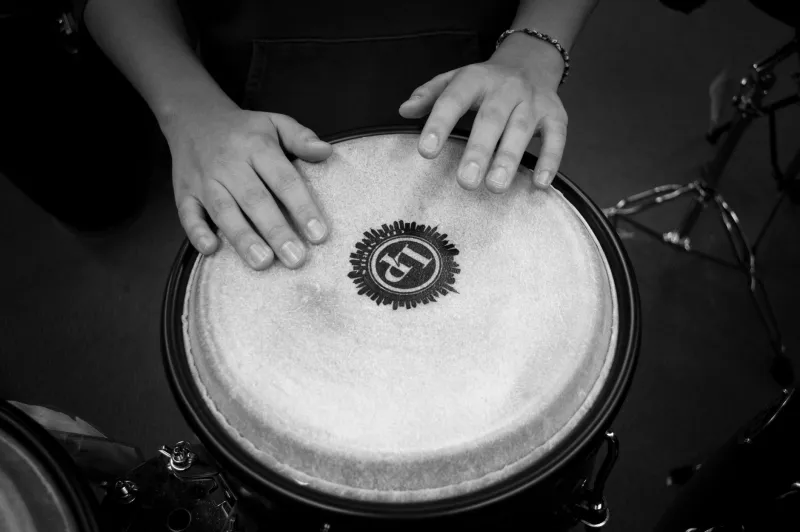
There's also something about the physical intimacy of the instrument that players find hard to articulate but impossible to ignore. A drum kit is a machine you operate. A bodhrán is something you hold in your lap, pressed against your body, its resonance moving through your chest. The experience of playing it is fundamentally personal in a way that a five-piece kit never quite is.
"It's just you and this circle of skin," says Caruso. "There's nowhere to go and nothing to add. That simplicity becomes the whole thing."
The Session as Teacher
Nearly every converted player points to the Irish session — that informal gathering of musicians playing traditional tunes together, usually in a pub — as the real classroom. There's no instructor at a session, no curriculum, and no patience for someone who plays over the music rather than with it. The feedback is immediate and social: if you're playing well, people smile and nod; if you're not, the energy in the room shifts in ways you can't miss.
For drummers used to rehearsals, charts, and bandleaders, that kind of unstructured, community-driven learning is its own education.
"Sessions taught me humility in a way that nothing else in music ever had," Webb says. "And I say that as someone who's played with people far more talented than me. There's something about sitting in a circle with a bunch of fiddle players and whistle players and knowing that your job is just to serve the tune — it rewires something."
The Long Way Around
None of this is to say that drumming experience is useless when approaching the bodhrán. Most converted players agree that their rhythmic foundation — their internal sense of time, their understanding of pulse and subdivision — gives them a genuine head start. The problem, if it can be called that, is the instinct to use all of it.
The bodhrán's great lesson, as it turns out, is one of subtraction. The instrument doesn't ask you to forget what you know; it asks you to know when not to use it. And for American drummers trained in a musical culture that celebrates more, faster, louder — that particular lesson lands like a revelation.
"I still play kit," Caruso says. "But the bodhrán changed how I play kit. It made me quieter, more patient. I listen differently now."
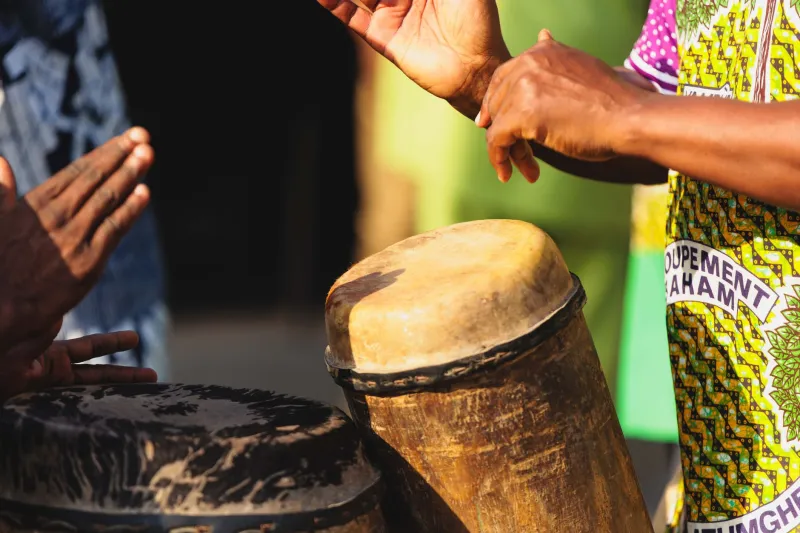
One drum. One stick. One skin stretched over a wooden frame. And somehow, in that almost absurd simplicity, a whole new way of hearing music.
That's the bodhrán's dilemma — and its gift.