Scroll, Dance, Speak: How Gen Z Found Their Inner Gael Online
Something unexpected is happening on your For You Page. Between the cooking hacks and the celebrity drama, there's a teenager in a Dublin kitchen teaching you how to say 'craic' correctly, and a college student in Boston dropping a céilí tutorial that's racking up half a million views. Gen Z didn't just stumble into Irish culture — they ran at it headfirst, phones in hand, and the results are genuinely remarkable.
A Language That Refused to Stay Quiet
Irish — or Gaeilge, if you want to use its actual name — has had a complicated few centuries. Suppressed under British rule, nearly wiped out by the Famine, and then propped up by well-meaning but often dry school curricula that made generations of Irish kids associate it with boredom rather than identity. For a long time, the narrative around the language leaned toward decline.
Then TikTok happened.
Accounts like @gaeilge_gach_la and a growing cluster of bilingual creators started posting short, punchy Irish language content — pronunciation guides, slang breakdowns, snippets of traditional songs with subtitles — and something clicked. The videos travel fast. A clip of a Connemara grandmother rattling through a sean-nós song with English captions can hit millions of views in a week. Comments sections fill up with Irish-Americans who had no idea their great-grandparents spoke this language, alongside Gen Z kids in Galway who are suddenly proud of something their parents told them was impractical.
Duolingo added Irish to its platform years ago, but the pandemic-era boom in language learning combined with the social media moment has pushed it into genuine cultural relevance. Irish consistently ranks among the more active language communities on the app, which surprises people who expect it to be a fringe interest. It isn't.
The Céilí Goes Viral
If the language revival is happening in comment sections and Duolingo streaks, the céilí dancing revival is happening somewhere louder and more joyful. Céilí — the traditional Irish social dance form involving group formations, live music, and a lot of organized chaos — has always been community-oriented by nature. You can't really do it alone. Which made it, paradoxically, perfect for social media.
Creators figured out that teaching the basic steps in short video format — the reel, the jig, the Siege of Ennis — was genuinely shareable content. Watch a group of college kids in matching chaos attempt a céilí dance for the first time and you've got comedy gold. Watch them nail it two weeks later and you've got something that makes people feel genuinely good about humanity.
In cities like Chicago, New York, and Boston — places with long-established Irish-American communities — traditional dance schools are reporting waitlists they haven't seen in years. The Comhaltas Ceoltóirí Éireann branches scattered across the US, organizations dedicated to preserving Irish music and dance, are suddenly fielding inquiries from twenty-somethings who found them through Instagram reels rather than family connections.
"We used to rely almost entirely on word of mouth and community ties," says one instructor at a Chicago branch who asked to remain anonymous because she was speaking off the record. "Now we're getting emails from kids in suburbs who have zero Irish background but fell down a TikTok rabbit hole and want to learn. That's new. That's genuinely new."
When the Algorithm Meets the Uilleann Pipes
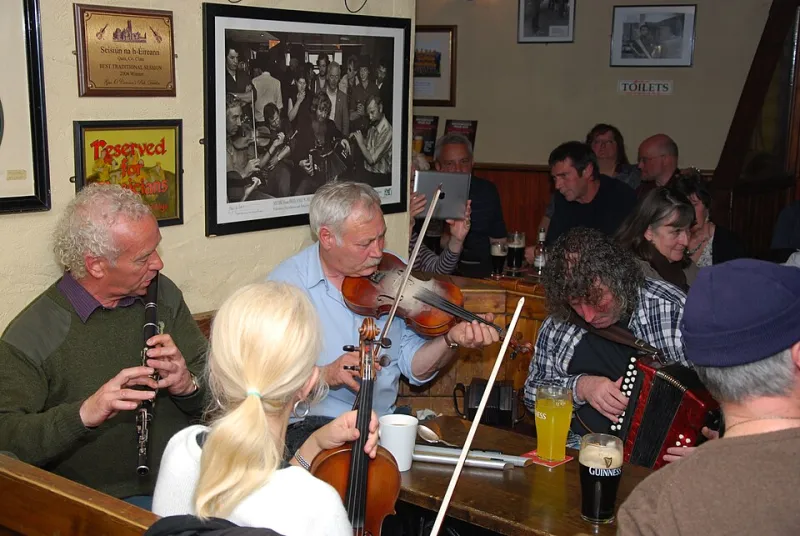
The music piece of this revival might be the most musically interesting corner of the whole phenomenon. Traditional Irish music — sessions, reels, jigs, slow airs — has always had a devoted global following, but it existed largely outside mainstream cultural conversation in the US. It was something you sought out, not something that found you.
Social media flattened that barrier completely. A teenage uilleann piper from County Clare posts a session video and it gets shared by a hip-hop producer in Atlanta who uses a sample in a track. A fiddle player from the Irish-American community in Philadelphia collaborates with a folk singer from Nashville — a connection that started in a comment section. These aren't hypothetical scenarios. They're things that happened.
Bands like Lankum and Ye Vagabonds — contemporary Irish acts with serious traditional roots — have built genuine US followings that skew younger than anyone expected, partly through organic social media sharing. When their music shows up in a video alongside a céilí tutorial or a language lesson, the algorithm treats it all as one connected ecosystem. Which, culturally speaking, it is.
What This Means for Irish-America
For the 35 million or so Americans who claim Irish heritage, this revival has a particular texture. Many of them grew up with St. Patrick's Day as their primary cultural touchpoint — green beer, corned beef, and a general vibe of celebration that didn't always go very deep. The current moment is different. It's specific. Kids are learning actual Irish phrases, not just "Erin go Bragh." They're learning the difference between a reel and a jig. They're looking up the counties their great-great-grandparents came from.
That specificity matters. It suggests a generation that wants more than a holiday — they want an actual cultural connection, and they're willing to build it themselves through whatever tools they have available.
Here at Sin É, we've always believed that Irish culture isn't a relic. It's a living thing that adapts and grows without losing its core. Watching Gen Z pick up a bodhrán or stumble through their first céilí or confidently drop a cúpla focal — a few words of Irish — in a TikTok comment section, it's hard not to feel like something genuinely exciting is happening.
The old traditions found new roads. They usually do.