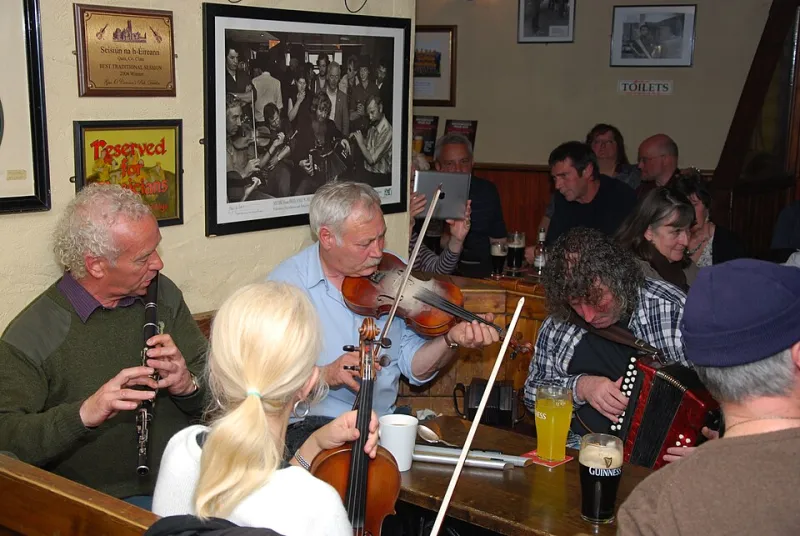
When the Fiddle Met the Steel Guitar: The Celtic Roots Running Deep Through American Country

Photo by Photo by Isaac Owens on Unsplash on Unsplash
Picture yourself at a honky-tonk in East Nashville on a Tuesday night. The performer on stage is fingerpicking a melody that sounds unmistakably familiar — not quite a reel, not quite a bluegrass run, but something beautifully in between. The crowd doesn't need to know the musicology behind it to feel it. They just lean in a little closer.
That pull? It's centuries old. And it's Irish.
The connection between Irish folk traditions and American country music isn't new — historians and musicologists have traced it back to the Scots-Irish settlers who carried their fiddles, ballads, and modal scales into the Appalachian mountains in the 18th and 19th centuries. But what's happening right now, in 2024 and beyond, feels different. It's intentional. Artists aren't just inheriting these sounds passively — they're actively seeking them out, studying them, and weaving them into work that's landing on playlists alongside mainstream country hits.
The Story Is Everything
Ask any Americana artist why Irish music resonates with country audiences and the answer comes back fast: the storytelling.
"Irish music doesn't waste a single word," says Raleigh-based singer-songwriter Mara Donnelly, who spent three months in County Clare studying with traditional musicians before recording her 2023 album Limestone & Longing. "Every song has a reason to exist. There's grief in it, humor in it, history in it. That's exactly what country music is supposed to be, and honestly, what it's been drifting away from."
Donnelly's observation touches on something a lot of country fans have been feeling without quite being able to name it. The narrative-driven, emotionally unguarded quality of traditional Irish music — sean-nós singing, in particular, with its ornamented, deeply personal delivery — mirrors what listeners respond to most in country at its rawest. Think early Townes Van Zandt, Gillian Welch, or Jason Isbell. There's no artifice. The song is the thing.
Nashville producer and multi-instrumentalist Cormac Sheridan, who grew up in Sligo before relocating to Tennessee in his twenties, has been bridging these worlds for over a decade. "Country and Irish traditional music share the same emotional DNA," he explains. "Both forms were built by working people processing hard lives through melody. You don't have to explain that to a listener in Knoxville or Kansas City — they already feel it."
Instruments Crossing Borders
Beyond storytelling, the actual instrumentation is where the cross-pollination gets interesting. The Irish bouzouki, the uilleann pipes, the bodhrán — these aren't instruments most Nashville producers would have considered five years ago. Today, they're showing up in Americana recordings with surprising frequency.
Texas-born artist Lena Caffrey, whose grandmother emigrated from Donegal, started incorporating the tin whistle into her live sets almost as a joke. "I learned it as a kid, kind of forgot about it, and then pulled it out at a show in Austin," she recalls. "The audience reaction was insane. People came up afterward asking what that instrument was, wanting to know more. It opened a whole conversation."
That curiosity is part of what's driving the trend. American audiences, particularly younger Americana fans who've grown up with genre-fluid Spotify playlists, aren't intimidated by unfamiliar sounds. If anything, they're drawn to them. The haunting quality of uilleann pipes or the driving pulse of a bodhrán offers something a standard drum kit simply can't — a texture that feels ancient and immediate at the same time.
Pentatonic and modal scales, the harmonic backbone of much Irish traditional music, also translate naturally into country and Americana contexts. Where a pop chord progression might feel predictable, these older scales introduce a sense of longing and unresolved tension that suits the themes country music lives in: loss, displacement, love that doesn't quite work out.
The Appalachian Thread
It's worth pausing to acknowledge that this isn't purely a modern import. The Appalachian old-time tradition — the foundation on which bluegrass and eventually country was built — has always carried the fingerprints of Irish and Scottish immigrants. Fiddle tunes like "Sally Goodin" and "Bonaparte's Retreat" have direct relatives in the Irish session repertoire. The call-and-response patterns in mountain ballads echo the communal singing traditions of the Irish countryside.
What's changed is awareness. Artists and listeners alike are more conscious of these connections now, thanks in part to documentaries, streaming platforms making world music accessible, and a broader cultural moment that values roots and authenticity over polish.
"I think people are hungry for music that has a 'where' and a 'when,'" says Sheridan. "Irish traditional music is so specifically located — in a geography, in a history. That's what makes it feel real. And real is what country music is supposed to be."
A Two-Way Conversation
Interestingly, the influence isn't flowing in just one direction. Irish musicians who've spent time in the US are returning home with country and Americana sounds in their ears, creating a transatlantic dialogue that's producing some genuinely exciting hybrid work. Bands in Galway and Dublin are quietly incorporating pedal steel and Americana song structures into their sets, while American artists are heading to Connemara and Kerry for creative residencies.
For listeners at Sin É, this convergence feels natural. The same qualities that make a great Irish session song — the communal energy, the emotional directness, the melody that lodges in your chest — are exactly what makes a great country record. These two traditions were always going to find each other again.
Next time you're at a show and you catch that familiar-but-not-quite feeling in a melody, lean into it. Chances are, it's older than you think — and it traveled a long way to reach you.