Once Upon a Whiskey: The Ancient Irish Art of Storytelling Is Having a Very American Moment
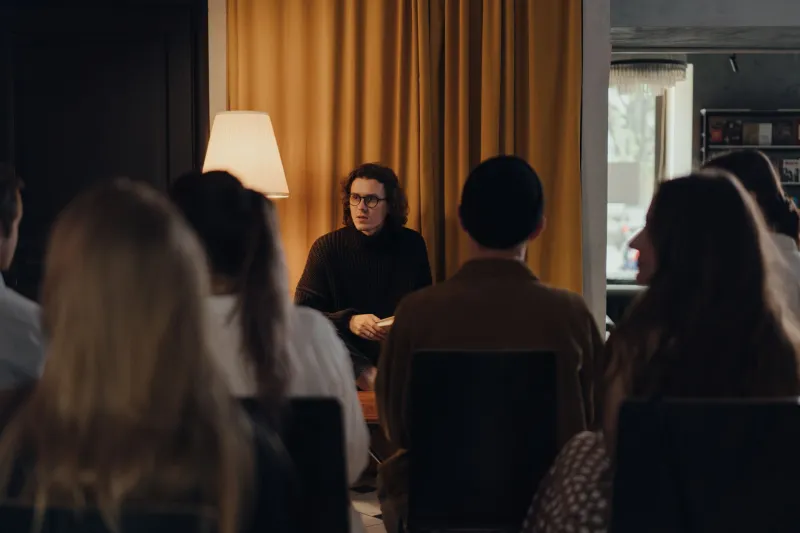
There's a particular kind of quiet that settles over a room when a good storyteller begins. Not the polite silence of a lecture hall or the distracted hush of a movie theater — something older than that. A leaning-in. A collective breath held just a little longer than usual. If you've experienced it lately in a whiskey bar in Brooklyn, a black-box theater in Chicago, or a converted warehouse event space in Austin, you might have stumbled into something that's been around for a very long time.
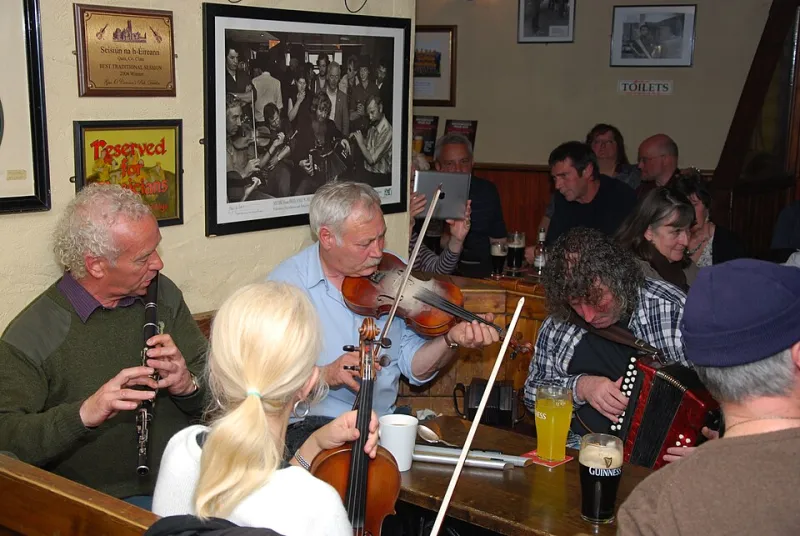
The séanchaí (SHAWN-a-khee) — the traditional Irish keeper of stories, genealogies, and community memory — is one of the oldest professional roles in Gaelic culture. For centuries, these traveling narrators moved between townlands, carrying histories and myths that existed nowhere in writing. They were part entertainer, part historian, part spiritual guide. And then modernity happened, and the tradition nearly disappeared.
Nearly.
The Old Craft in New Rooms
In American cities with strong Irish-American populations — Boston, New York, Chicago, Philadelphia — live storytelling events rooted in the séanchaí tradition have been quietly building audiences for the better part of a decade. But something has shifted recently. The crowds are younger. The venues are hipper. And the people showing up often have no particular connection to Ireland at all.
"I think people are genuinely hungry for something unmediated," says Fionnuala Brennan, a Galway-born storyteller who now splits her time between Dublin and New York, where she performs regularly at intimate venues in the West Village and Brooklyn. "You're not watching a screen. You're not wearing headphones. There's one person in a room with you, and they're going to take you somewhere with nothing but language and breath and the oldest technology we have — the human voice."
Brennan's shows blend traditional Irish tales — the mythological cycles, the folklore of the west of Ireland, the ghost stories that every Irish grandmother apparently had on tap — with her own contemporary observations about being Irish in America. The result is something that feels both ancient and completely current.
"The séanchaí never just recited," she explains. "They responded to the room. The same story told in Kerry and in Donegal would be different stories. I try to honor that. Every audience gets something slightly different."
Whiskey as Social Technology
It's probably not an accident that the revival of this kind of storytelling is happening in whiskey bars and similar intimate venues. Irish whiskey has undergone its own remarkable American renaissance over the past decade — brands like Redbreast, Green Spot, and a wave of craft distilleries have helped shift the category from an afterthought to a genuine connoisseur's drink. And whiskey, culturally, has always been adjacent to conversation.
"There's something about a good pour that slows people down," says Marcus Webb, who organizes a monthly storytelling night called The Hearth at a whiskey-focused bar in Philadelphia. Webb is African-American and came to Irish storytelling through a graduate program in folklore studies. "People come in distracted, phones out, whatever. But once the lights go down and someone starts talking — really talking, in that deliberate way — the room changes. I've seen it happen hundreds of times and it still gets me."
The Hearth features a rotating cast of storytellers, not all of them Irish or Irish-American. Webb's programming philosophy is deliberately expansive — he sees the séanchaí tradition as a framework that can hold all kinds of voices and all kinds of stories, as long as the commitment to craft is there.
"The tradition asks certain things of you," he says. "Presence. Memory. The ability to read an audience. Those aren't Irish skills — those are human skills. But the Irish kept them alive in a particular way, and I think we owe that some respect."
Preserving the Real Thing
Not everyone in the storytelling world is comfortable with how freely the séanchaí label gets applied. Dr. Siobhán Ní Fhaoláin, a folklorist at a Boston university who studies Irish oral tradition, appreciates the renewed interest but urges some care.
"The authentic séanchaí tradition is specific," she says. "It comes out of a particular linguistic and cultural context — Irish-language communities, specific regional styles, a relationship to the land and to history that you can't just lift out and drop somewhere else. When people use the word, I'd love for them to know what they're referencing."
That said, she doesn't dismiss what's happening in American venues. "There's a difference between appropriation and genuine engagement. What I see from a lot of these contemporary storytellers is genuine engagement — they've done the research, they've learned some Irish, they've traveled, they've listened to the surviving traditional storytellers. That matters."
Brennan herself is almost evangelical on this point. She spent two years in the Connemara Gaeltacht — the Irish-speaking region of County Galway — specifically to immerse herself in the oral tradition before she felt entitled to perform it professionally.
"You don't get to skip the work," she says simply.
Why Now?
The timing of this revival prompts an obvious question: why are Americans, in the age of infinite podcasts and on-demand everything, seeking out a guy or a woman in a chair telling them a story with no visual aids, no production value, and no pause button?
Maybe the answer is obvious. We've had infinite podcasts and on-demand everything, and something is still missing.
"Connection," says Webb, without hesitation. "Real-time, unrecorded, this-moment-only connection. You can't download what happens in a room when a story lands right. That's the whole point."
Brennan puts it a little differently. "The Irish have always known that stories are how you survive," she says. "Hard winters. Famine. Emigration. You tell the story to remember who you are. I think a lot of Americans are trying to figure out who they are right now. And maybe sitting in a dark room with a whiskey, listening to someone talk about the old world, helps with that a little."
Pull up a chair. The night is young.