Living Room Trad: The Suburban Americans Turning Their Homes Into Irish Session Havens
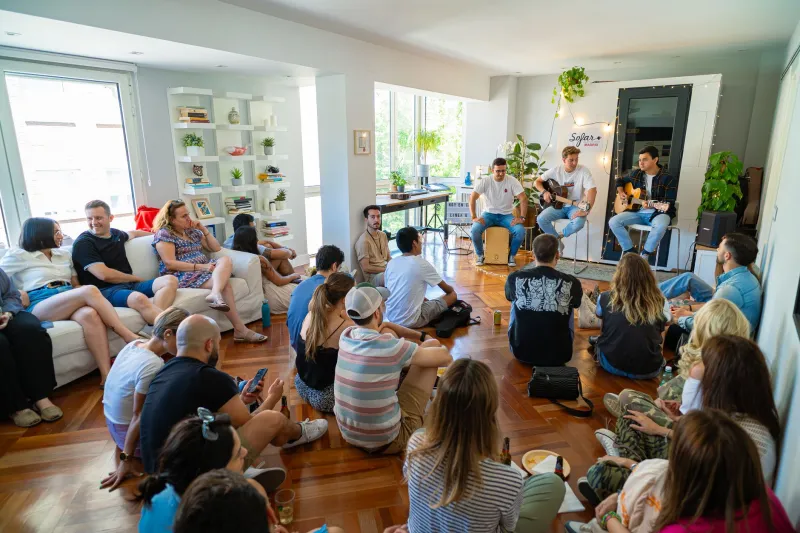
There's a fiddle case propped against a coat rack in Karen Molloy's entryway in Naperville, Illinois. Next to it, a tin whistle in a zip-lock bag and somebody's forgotten capo. On any given third Saturday of the month, her living room furniture gets shoved against the walls, folding chairs appear from the garage, and somewhere between twelve and thirty people squeeze in to play Irish traditional music until the neighbors either join them or accept their fate.
"I started it because I missed it," Karen says simply. She spent two summers in County Clare in her twenties, fell deep into the session culture there, and came home to the midwest carrying a hunger she couldn't quite satisfy at the local Irish bar. "The pub sessions are great, but there's something about a house. You're not competing with a game on TV. You're not worried about last call. You just play."
Karen isn't alone. Across the United States — in suburbs that look nothing like the west of Ireland and in cities that have never hosted a Fleadh — a growing network of home-based céilís and informal trad sessions is quietly reshaping how Americans connect with Irish music and culture. These aren't polished performances or ticketed events. They're potlucks with bouzoukis. They're BYOB and bring your bodhran.
What Even Is a House Céilí?
For the uninitiated, a céilí (pronounced KAY-lee) traditionally refers to a social gathering involving Irish music, dancing, and storytelling. The house céilí takes that spirit and strips it down to its most essential form: people in someone's home, playing tunes, sharing food, and staying way too late on a weeknight.
The Irish tradition of the "kitchen session" — where neighbors would gather informally around a hearth to play and sing — predates any pub or concert hall. What's happening in American suburbs right now isn't a pale imitation of that tradition. For many participants, it's the closest living approximation of it outside of Ireland itself.
Dan Fitzpatrick, a flute player in suburban Atlanta who hosts monthly sessions out of his Decatur home, puts it this way: "In a pub session, there's always a hierarchy. The serious players sit in the center, beginners hover at the edges. At my house, we don't do that. My kitchen table is the circle. Everyone's in."
The Pandemic Planted the Seed
If there's a single turning point that accelerated this movement, most hosts point to the pandemic years. When pubs closed and festivals went dark, musicians who'd relied on those spaces suddenly had nowhere to go. Online sessions on Zoom and FaceTime kept some connections alive, but they also revealed just how hungry people were for the real thing — the physical presence of other musicians, the way a tune feels different when you're in the same room as the fiddle.
When restrictions lifted, a lot of people didn't go straight back to the bar. They went to each other's houses instead.
"We started outside, actually," recalls Siobhan Reilly, who runs a backyard session in her Portland, Oregon neighborhood. "Just me and three other people in lawn chairs. Now we have a canopy, a fire pit, and a waiting list for folding chairs."
Siobhan's gatherings have since become a genuine neighborhood institution. Her next-door neighbor, a retired schoolteacher with no prior interest in Irish music, started showing up just to listen. Six months later, he bought a tenor banjo. "He's terrible," Siobhan laughs affectionately. "He's absolutely terrible and he comes every single time and we love him."
Building the Tune from Scratch
One of the most striking things about the house céilí phenomenon is how it's functioning as an on-ramp for complete beginners. Traditional Irish music has a reputation — not entirely unfair — for being intimidating to newcomers. The tunes are fast, the repertoire is vast, and sessions can feel like a closed club if you don't already know the language.
House sessions, by their nature, tend to dissolve those barriers. There's no stage, no microphone, no audience to impress. When you're sitting in someone's living room eating homemade soda bread, the pressure drops considerably.
Marcus Webb, a Black American musician from Columbus, Ohio who plays concertina, credits a local house session with giving him a foothold in a tradition he'd admired from a distance for years. "I'd tried to sit in at pub sessions a couple times and felt like I was crashing someone's party. The house session was different. The host literally texted me before I came and said, 'We'll slow down for you, don't worry.' That was it. That was the whole thing."
Marcus now helps run a beginner-friendly offshoot session that feeds into the main gathering — a model several hosts have adopted to keep their communities growing without overwhelming newer players.
The Social Architecture of a Good Session
Ask any experienced host and they'll tell you: running a great house session is more social work than musical work. You're managing energy, pacing, the delicate dynamics of who leads tunes and when. You're making sure the quiet tin whistle player in the corner gets heard. You're knowing when to call a set and when to let things run free.
Karen Molloy has developed what she half-jokingly calls her "session constitution" — informal house rules she shares with first-timers. No requests for songs while tunes are being played. If you don't know a tune, listen and join when you can. Phones down during sets. And critically: everyone helps stack chairs at the end.
"It sounds like a lot of rules for something that's supposed to be casual," she admits. "But those rules are actually what makes it feel free. Everyone knows what to expect, so no one's anxious."
The food dimension shouldn't be underestimated either. House sessions run on potluck energy. There's something about a spread of contributed dishes — someone's Irish stew, someone else's attempt at brown bread, inevitably a box of Tayto crisps that someone ordered online — that completes the communal feeling.
Why It Matters Beyond the Music
For a lot of participants, the house céilí has become something they didn't know they were looking for: a third place. Not home, not work, but a community gathering point with its own rhythms and rituals. In an era when Americans increasingly report feeling isolated and disconnected from their neighbors, a monthly living room session turns out to be quietly radical.
"I know more about the people in this session than I know about most of my coworkers," says Dan Fitzpatrick. "We've played through divorces, job losses, a couple of deaths. The music holds all of it."
That's a very Irish thing to say, actually. And maybe that's the point. The tradition was never really about the tunes themselves — it was about the people gathered around them. Ireland figured that out centuries ago in its kitchens and crossroads. America, it turns out, is figuring it out now in its living rooms and backyards.
If you listen on the right Saturday night, you might just hear it from the end of someone's cul-de-sac — a fiddle rising, a flute answering, and the sound of something old and necessary coming back to life.
Looking to find or start a house session in your area? Check out the Irish Traditional Music Archive's session finder or connect with your local Comhaltas Ceoltóirí Éireann chapter — many chapters can point you toward informal gatherings that never make it onto any official calendar.